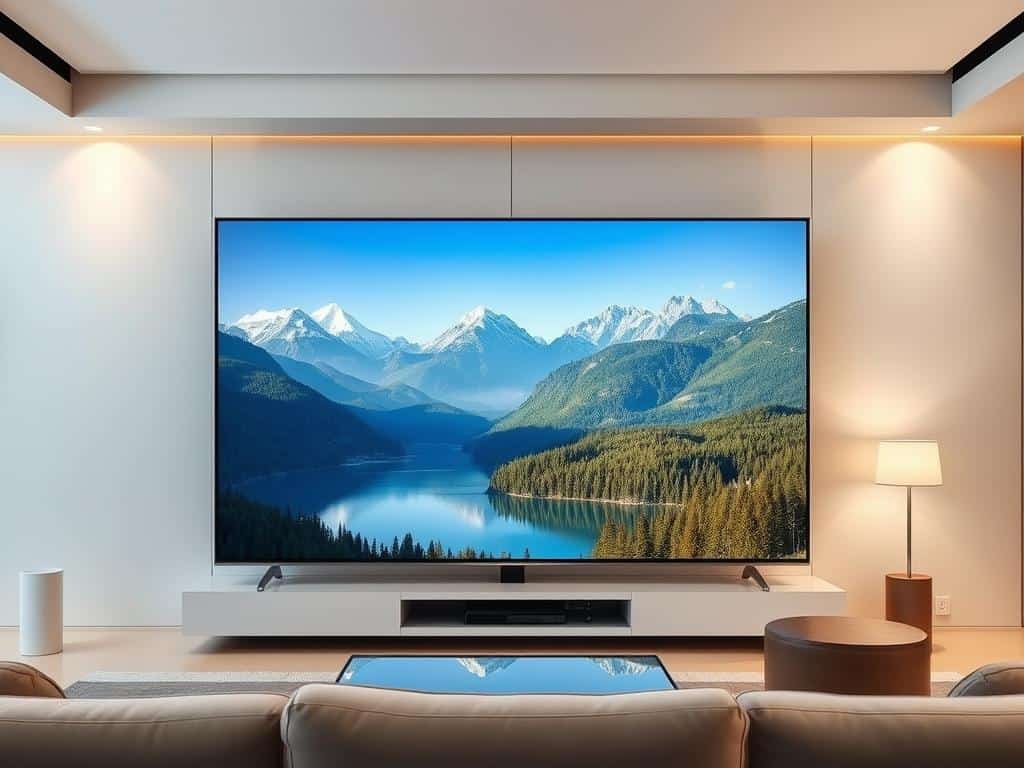
As I settled into my living room, ready to unwind with a movie, my new 8K TV caught my eye. It promised a viewing experience unlike any other. With all the talk about 8K resolution and next-gen display tech, I wondered: is it worth it? Just last year, I upgraded to a 4K TV and was amazed by the sharpness. Now, I was considering another big step, but at a higher cost and with less content available.
I adjusted the TV settings, thinking about the price and limited content. I knew I had to explore further to see if this upgrade was right for me and others like me.
Key Takeaways
- 8K resolution provides four times the pixels of 4K, making visuals clearer.
- Currently, there’s not much 8K content, making it hard to justify the cost.
- Upscaling tech helps improve the 8K TV experience.
- 4K TVs offer great quality at a lower price.
- While 8K looks promising for the future, it might not be the best choice now.
Understanding 8K Resolution and Its Position in the Market
Exploring display technologies, I often hear about 8K resolution. It has a resolution of 7680 x 4320 pixels, with about 33 million pixels. This is more than 4K, promising clearer images. But, I wonder if we really notice the difference at normal viewing distances.
What is 8K Resolution?
8K resolution makes images look incredibly detailed and deep. With so many pixels, pictures seem more real. This makes watching them on the best TVs even more immersive. But, I question its everyday use when there’s not much 8K content out there.
The Current Landscape of 8K TVs
Big names like Samsung, Sony, and LG are selling 8K TVs. These Ultra HD models are for those who love the latest tech. But, they’re expensive, making them hard for most people to buy. The prices of 8K TVs are way higher than quality 4K TVs, which are great for most viewers.
Is 8K Worth It?
Exploring the world of display technology, we must ask if 8K resolution is worth it. These ultra-high-definition models bring up questions about content and image quality. We find both the good and bad sides for consumers.
Limitations in Content Availability
One big issue with 8K TVs is the lack of content. Right now, only a few movies and shows are in 8K. This can make viewers feel like they’re not getting their money’s worth, given the high cost of top TVs. Most content is in lower resolutions, so buyers need to think about how often they’ll watch 8K.
Upscaling Technology and Image Quality
Upscaling tech is key to the 8K experience. It makes lower-resolution media look better on bigger screens. Many 8K TVs have advanced upscaling, making older content look better. These TVs can make any content look clearer, but how well it works depends on the brand and model.
The Case for 4K TVs
Considering the current content situation, 4K TVs are a smart choice. They offer great quality at a lower price, with more content available. I believe 4K TVs are a better value, giving you great visuals without the high cost of 8K. It might take time for 8K to become more common.
Conclusion
Exploring 8K resolution reveals key points. While 8K TVs have over 33 million pixels, most people can’t see a big difference. You need to sit very close to a big screen to notice, which isn’t common.
Another important point is the lack of 8K content. Big names like Netflix and Amazon Prime Video don’t offer 8K yet. They face issues with bandwidth and compression. Even if they upscale content, the improvement is small.
If you’re looking for top TVs, 4K models are worth considering. A 65-inch QLED 4K TV costs around $1,497, while an 8K one is over $4,997. This shows 4K TVs are a better deal for most people. Think about your viewing habits and whether 8K is worth it compared to 4K.