I’ve spent hours gaming on my laptop, often facing lag in my favorite games. I found external GPUs online and was excited to boost my laptop’s power. Now, I can enjoy stunning graphics and smooth gameplay from my laptop.
This article explores how external GPUs can change your gaming experience. They make your laptop a gaming powerhouse. You’ll learn how to set up an eGPU and unlock your laptop’s full gaming capabilities.
Key Takeaways
- External GPUs can significantly enhance laptop gaming performance.
- Understanding external GPUs explained is key to maximizing their benefits.
- Compatibility is critical for a smooth eGPU setup.
- Choosing the right external graphics card is essential.
- Setting up an external GPU is easy and rewarding.
Understanding External GPUs
An external GPU, or eGPU, is a key tool for boosting laptop graphics. It lets users enjoy desktop power on the go. Let’s explore what an eGPU is and how it works, focusing on its importance in eGPU technology.
What is an External GPU?
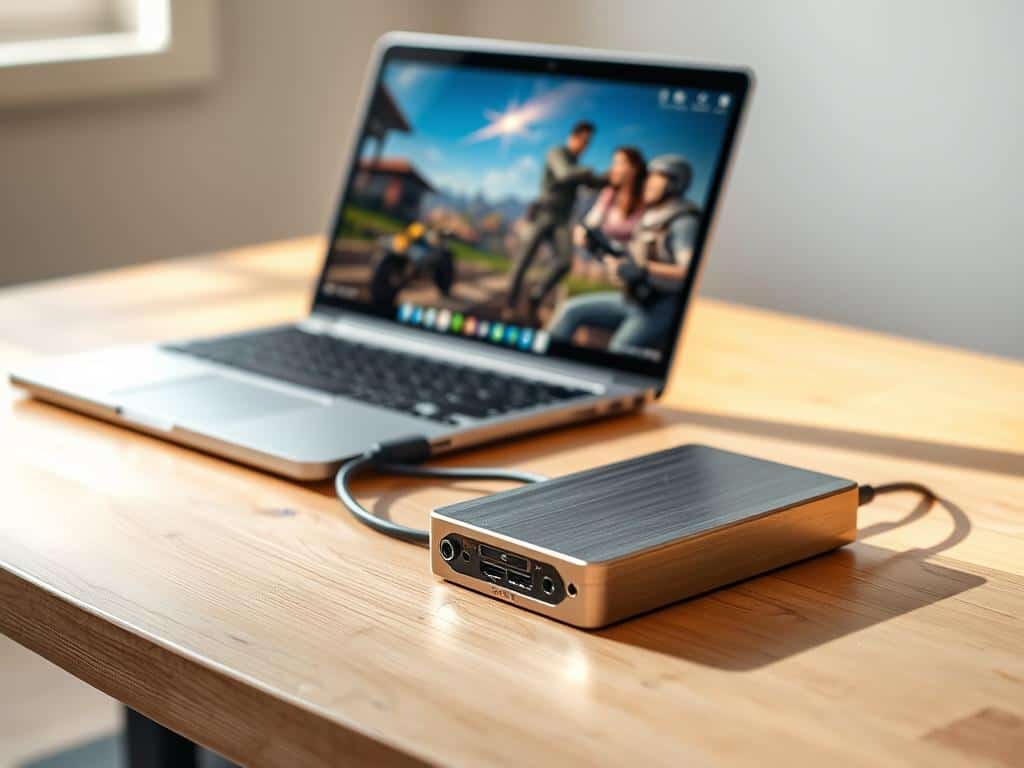
An external GPU is a separate graphics card in an outside box. It plugs into a laptop via Thunderbolt 3. This setup lets laptops use powerful graphics cards, making games and videos better. Now, I can get desktop-level gaming without a big desktop.
How Do External GPUs Work?
eGPUs connect to laptops via Thunderbolt 3. This link provides fast data transfer, up to 40 Gbit/s. When I plug in an external card, my laptop uses it right away.
This makes my games and graphics work better. It’s all about getting more power without hassle.
External GPUs Explained
Understanding the benefits of external GPU technology is key for better gaming. These devices turn regular laptops into gaming powerhouses. They handle new games well without losing visual quality.
External GPUs also cool better and can be upgraded more easily than built-in graphics. I can change graphics cards in them, making it easy to keep up with new tech.

Before exploring the external graphics card advantages, I check if my laptop can handle an eGPU. I look for a Thunderbolt 3 port or Mini PCIe slot. It’s also important to make sure my laptop’s BIOS supports the eGPU.
When picking the best external graphics cards, I look at reviews and performance. Cards like the Nvidia GeForce GTX 1060 and AMD Radeon RX 580 offer great performance. I also check online forums for graphics card recommendations and benchmarks.
It’s vital to check if the graphics card and enclosure are compatible. Knowing how different cards perform is key to a good gaming experience. By choosing wisely, I can greatly improve my gaming.
Setting Up Your External GPU
Setting up an external GPU (eGPU) needs careful preparation and the right tools. This section will cover the essential tools and materials for a successful installation. It also includes a detailed step-by-step guide to help you through the setup process.
Tools and Ingredients Needed
To start the eGPU installation, gather the necessary tools and materials. You’ll need a compatible laptop, like the Asus N43SL-VX264D, as a base for your gaming laptop modification. An eGPU enclosure, such as the EXP GDC V8.0, and a desktop graphics card, like the Zotac GTX 950, are also required. A compatible power supply unit (PSU) is essential for powering the setup.
Make sure you have the right peripherals, including an external monitor, keyboard, and mouse. You’ll also need a USB Wi-Fi adapter or a LAN cable for internet. Basic tools like a screwdriver or a cutting tool, if needed for laptop casing modification, are also essential.
Step-by-Step Guide to eGPU Installation
Follow this eGPU installation guide for a smooth setup. First, check your laptop’s compatibility. Open it up and find the WLAN slot interface, which could be Mini PCIe, NGFF, or ExpressCard. Make sure the laptop’s BIOS settings allow unauthorized hardware for a successful connection.
After confirming compatibility, gather all the required tools and components. Start by replacing the WLAN card with the eGPU enclosure’s interface cable. Ensure a solid connection.
Next, connect an HDMI cable from the eGPU to your external monitor. Plug in the power cables to the PSU. Insert the graphics card into the eGPU enclosure, making sure all power connectors are attached properly.
Power on the laptop, ensuring all devices are plugged in. As soon as you boot into Windows, you may need to install the GPU drivers. Get the latest drivers from the official graphics card manufacturer for better compatibility. Restart the laptop after installation to apply changes.
Lastly, navigate to the display settings and set the external monitor as the primary display for gaming. This will maximize your gaming experience with the enhanced graphics from your eGPU setup.
Conclusion
External GPUs have changed the game for laptops, making them powerful for gaming. They let me get desktop-level graphics without losing portability. This has been a huge upgrade for me.
Looking ahead, I’m excited for what eGPUs will bring next. They’re getting better and more user-friendly. This will make my gaming and work even better.
In the end, getting an eGPU was a smart move. It turned my laptop into a gaming powerhouse. I’m looking forward to seeing how eGPUs will keep improving for all of us.